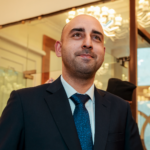

Kathmandu, 2026
I want to write down why Practical AI Nepal exists, while the reason is still clear to me, so that whoever carries this work after me knows what it was for.
For most of my working life I have watched where technology comes from, and where it goes. It comes, almost always, from the West — born in a handful of labs and companies that have never been to Nepal and were not thinking about it. For a long time I assumed that was simply the order of things: that places like theirs would make, and places like ours would receive.
But that is not what I actually saw happen. I watched the open movements — open source, open models, open knowledge — take what was born in those labs and carry it outward, and the momentum kept landing in unexpected places. In regions like mine. In regions living under conditions like ours. First we consumed what was made. Then, quietly, we began to give it direction. The problems worth solving, the designs that fit real constraints, the markets that actually mattered, the decisions about talent and technology — more and more of these came from where I was standing, not from where the technology was born. And with every passing year this has proven more true, not less.
I knew this before I had words for it, because my own early work taught me. In 2018 I helped build a system that recognised Nepali paper currency for blind and visually-impaired people, running entirely on a phone, completely offline — because the people who needed it could not depend on the internet, and no one abroad was ever going to build it for them. After the 2015 earthquake, I worked on using AI to assess which houses had been damaged and which needed retrofitting — a problem that existed here, mattered here, and could only be understood here. The tools underneath were born elsewhere. The purpose, the judgment, and the impact were entirely ours.
So when artificial intelligence arrived in its newest and most powerful form, the old arrangement stopped being acceptable to me — not out of grievance, but because I had already seen the better arrangement with my own eyes.
Not because the tools are bad — they are extraordinary. But because AI is not a tool like a spreadsheet or a search engine. It decides. It mediates language, judgment, knowledge, and increasingly, opportunity. A society that can only consume such systems, never govern them, run them, evaluate them, or shape them, is a society that has quietly agreed to let its institutions, its languages, and its judgments be administered by machines it does not understand and cannot question. I was not willing to agree to that on Nepal’s behalf. I do not think anyone should.
So the question that produced this initiative was narrow and stubborn: not whether Nepal could imagine a future with AI — anyone can imagine — but whether Nepal could build the practical ability to use, govern, run, adapt, evaluate, and improve these systems on terms it sets for itself. Capability, not consumption. Sovereignty, understood not as isolation but as having a choice. Quality, held honestly, instead of hype.
I chose the word practical deliberately, and I want it defended after I am gone. There will be pressure to become a place that issues opinions, attends summits, and accumulates prestige. That is the easy version, and it is a slow death. This was meant to be a working place — one that measures what actually works, trains the people who actually need training, builds the things that actually have to exist, and tells the truth about what fails. Authority here is meant to be earned through evidence, never asserted through position. If this work ever starts asserting more than it has built, it will have betrayed its founding.
I also want to record what this is not. It is not mine, and it was never meant to stay mine. It is not a vehicle for any company, including my own. It is not a Nepal-only project pretending to global relevance, nor a globally-imitative project ashamed of being Nepali. It begins here because here is where I stand, and because the problems we face — small economy, under-resourced, building capability without inherited advantage — are not ours alone. Most of the world is in our position, not in Silicon Valley’s. If we solve these problems well and in the open, the work will travel. From Nepal, to the region, to everyone standing where we stand.
I have no illusion that this will be finished in my lifetime, and I have arranged the work so it does not need to be. The point was never to arrive. The point was to begin something with strong enough momentum that the situation’s own logic carries it forward — to shape the ground so thoroughly, so far upstream, that capability in this country becomes not an aspiration but an inevitability.
That is the whole of it. Build the capability. Keep it honest. Keep it open. Hand it on.
If you are reading this and the work is still alive, then the beginning holds.
— Kshitiz Rimal, Founder